Water Extraction in North Port, FL
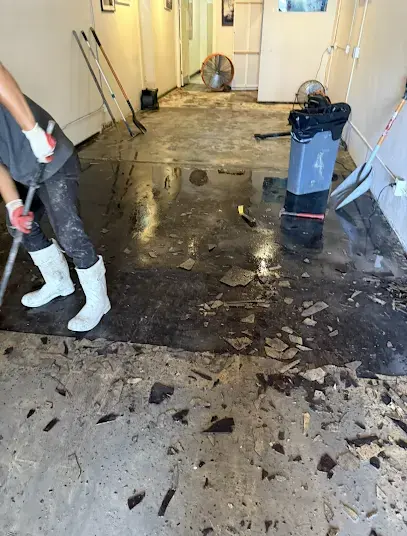
Standing water on a slab floor does not sit still. It runs under baseboards, into the bottom of block walls and under tile and laminate. The extraction crew pulls it out with truck-mounted and portable units before the drying starts.
(888) 621-2041Get the North Port pump-out started- 24/7 dispatch
- Truck-mounted extraction
- Moisture mapping first
What to do the moment you find standing water
- 1
Stop the source
Shut the main valve, usually where the supply enters the house or at the well pump switch in the garage.
- 2
Kill power to wet circuits
Only at a dry breaker panel. If the panel or the floor around it is wet, leave it alone.
- 3
Stay out of deep or dirty water
Water near outlets can carry current, and flood water from outside is Category 3.
- 4
Photograph, then lift
Photos of every wet room first, then rugs, boxes and electronics up off the floor.
What does water extraction cost in North Port, FL?
In North Port, FL, water extraction on its own typically runs $400 to $1,500 for one or two rooms, and $1,500 to $4,500 when water covered much of a slab home. Extraction plus full structural drying usually lands between $1,800 and $7,000, depending on the water category, the square footage and the flooring.
One or two rooms
$400 to $1,500
- Clean water, caught early
- Tile, vinyl or laminate
- Portable or truck-mounted unit
Most of a slab home
$1,500 to $4,500
- Carpet and pad saturated
- Water under baseboards
- Several extraction passes
Extraction plus drying
$1,800 to $7,000+
- Air movers and LGR units
- Daily readings to the goal
- Category 3 costs more
For a planning number on your own loss, try the water damage cost calculator. The final figure comes from the on-site walkthrough and the moisture map.
How water extraction is handled in North Port
Map the water
Thermal imaging and pinless meters show how far the water ran under flooring and into walls.
Extract
Truck-mounted units and weighted extraction tools pull water out of carpet, pad and tile grout lines.
Set the drying
Air movers and LGR dehumidifiers go in, sized to each room's evaporation load.
Read daily
The drying team logs readings every day until the structure is dry.
Water extraction is the first job on almost every water loss in North Port. The more water that comes out as liquid, the less has to be pulled out of the air later, which shortens the drying and keeps more of the house.
Why extraction comes first on a slab home
Most North Port homes sit on a concrete slab with concrete block walls. When water spreads across that slab it moves in three directions at once: under the flooring, into the bottom course of drywall and into the block itself. Each one is harder to dry than the last.
- Carpet and pad hold several times their weight in water until they are extracted.
- Laminate and engineered wood trap water underneath, where no fan can reach it.
- Drywall wicks water up from the floor, often a foot or more within a day.
The extraction crew works room by room, starting where the water is deepest, and keeps the meter readings from the first pass for the file.
Truck-mounted and portable extraction
Truck-mounted extraction sends the water out of the building instead of into the next room, and it moves far more water than a shop vacuum. Portable units reach upstairs rooms, condos and spots a hose cannot. Weighted extraction tools press water out of carpet and pad so that more of it can be dried in place.
Clean water, gray water and flood water
The source decides the category. A burst supply line is Category 1, a washer discharge is Category 2, and water from a septic backup or from outside during a storm is Category 3. Category 3 water changes the job: porous materials it touched come out, and the crew works with containment and an EPA-registered antimicrobial. See flood water cleanup and septic and sewage backup cleanup for how those are handled.
What happens after the water is out
Extraction ends, drying begins. Air movers and LGR dehumidifiers are set to the load of each room, and the equipment stays until readings show the materials are dry, which is the structural drying phase. Mold can begin to grow on wet materials within 24 to 48 hours, so the order of work matters more than any single piece of equipment.
For general safety steps around a flooded home, the Ready.gov flood page and the Florida Division of Emergency Management are both worth a look.
Water Extraction questions
How fast does water need to be extracted?
As soon as possible. Water keeps moving under flooring and into walls, and wet materials can start growing mold within 24 to 48 hours. Emergency water calls are treated as urgent at any hour.
Can a wet carpet be saved after extraction?
Often, yes, when the water was clean and extraction started early. The pad is usually replaced because it holds water and dries slowly. Carpet touched by Category 3 water is removed.
Is a shop vacuum enough?
For a small spill, maybe. For water across a room, a shop vacuum leaves most of it in the carpet, pad and grout. Truck-mounted extraction removes far more, which cuts the drying time.
Does extraction dry the walls too?
No. Extraction removes liquid water. Walls, slab and framing are dried afterward with air movers and dehumidifiers, and readings confirm when they are dry.
Why does the source of the water matter?
It sets the category. Clean supply water is handled differently from washer water or flood water from outside, and Category 3 means porous materials come out rather than being dried.
What should I move before the crew gets there?
Rugs, boxes, electronics and anything on the floor, after you photograph the room. Leave heavy furniture unless it is easy to lift onto blocks or foil.
Related water damage services in North Port
Covering North Port and nearby Sarasota and Charlotte County
The North Port restoration crew works every ZIP from 34286 to 34291, from Wellen Park to Toledo Blade Boulevard, plus Port Charlotte, Murdock, El Jobean, South Venice, Venice, Englewood.
See every North Port area coveredWater on the floor in North Port right now?
Every hour water sits on a slab it moves further under flooring and up the block. Extraction first, drying second.